Sinking and loss of life
Workboat Captain Jim
Approximately 4 NM southeast of Halifax Harbour, Nova Scotia
Summary
On 29 January 2019, the workboat Captain Jim, with 2 crew members and 1 passenger on board, began taking on water and became disabled 2.8 nautical miles from its home port of Eastern Passage, Nova Scotia. A short time later, the vessel sank rapidly. One of the crew members and the passenger managed to board the vessel’s life raft. They were rescued by a Halifax Harbour pilot boat and taken to Halifax, Nova Scotia. Divers located the body of the other crew member inside the vessel’s wheelhouse later that day.
1.0 Factual information
1.1 Particulars of the vessel
Name
Captain Jim
Official number
328374
Port of registry
Saint John, NB
Gross tonnage
14.78
Type
Workboat
Materials
Reinforced plastic
Registered length
11.37 m
Built
1989
Propulsion
1 diesel engine providing 158 kW
Maximum complement
14 (maximum 12 passengers, minimum 2 crew)
Registered owner
RMI Marine Limited
1.2 Description of the vessel
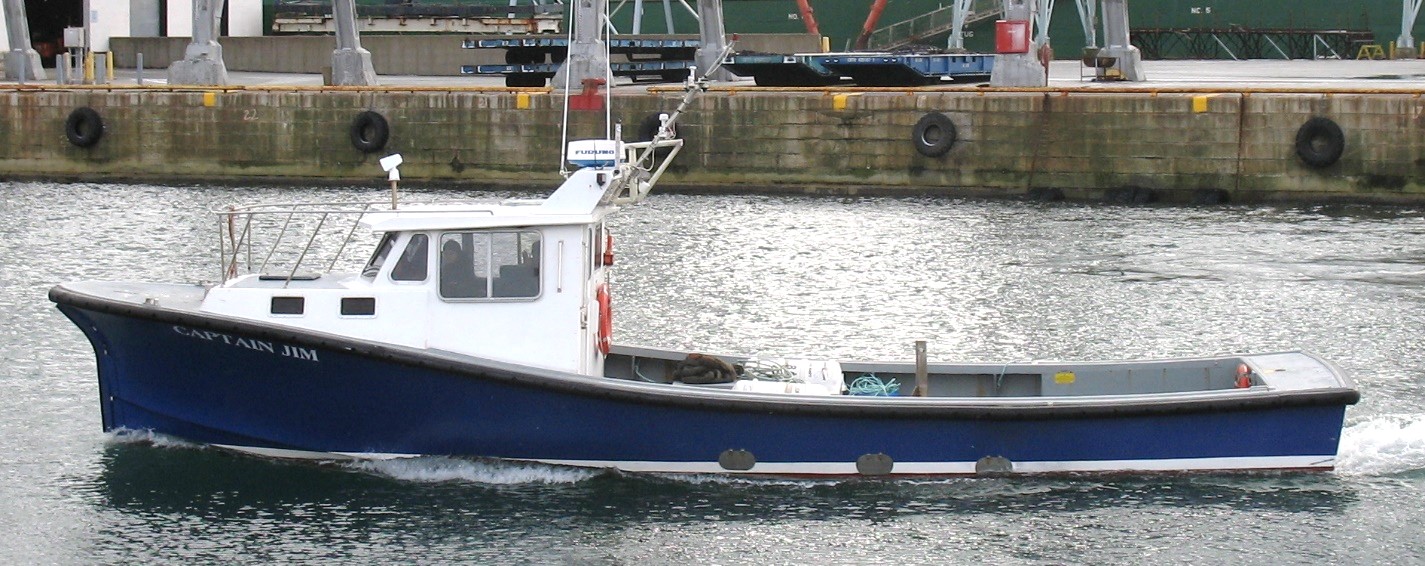
The Captain Jim was purchased by RMI Marine in 2004 for use as a multi-purpose workboat and was operated primarily as a passenger vessel for transporting people to work sites (Figure 1). The wheelhouse was equipped with electronic equipment consisting of 2 very high frequency (VHF) radiotelephones, a radar, a chart plotter and a global positioning system. There were floodlights and 2 life rafts on top of the wheelhouse at the time of the occurrence.
Figure 1. The Captain Jim (Source: Mac Mackay at Tugfax)
There were 4 hatches and a raised coaming around the engine compartment (Figure 2). Since the Captain Jim was an undecked vessel, the hatches and coaming were designed to be weathertight, but not watertight, and water that entered the vessel accumulated in the bilge.
Figure 2. View of the wheelhouse from aft showing raised coaming around engine compartment and one of the hatch covers (Source: Third party, with permission)
The vessel was fitted with 2 electric bilge pumps and 1 engine-driven pump. One bilge pump was located forward, in the engine compartment, and was set to activate automatically if triggered by a float switch in the bilge. The other bilge pump was located aft, in the lazarette, and was activated manually using a switch in the wheelhouse. The engine-driven pump was located in the engine compartment (Appendix A). It was designed to be used as a firefighting pump to assist other vessels but was generally used as a washdown pump for cleaning the deck; it could also be used to pump the bilge.
The port and starboard sides of the vessel each had 3 freeing ports, installed in July 2008, with hinged aluminum flaps. Subsequently, a securing arrangement was installed on each freeing port to allow the aluminum flaps to be fastened shut (Figure 3). The workboat also had 2 scuppers just aft of the stern-most freeing ports. The scuppers could be fitted with screw plugs but were normally left open.
Figure 3. View from the wheelhouse facing aft, with inset photo of starboard aft freeing port and scupper. Following the occurrence, TSB removed the hatch covers and raised coaming for examination purposes. (Source: TSB)
1.3 History of the voyage
At approximately 2145Footnote1 on 28 January 2019, the Captain Jim departed the RMI Marine dock in Eastern Passage, Nova Scotia, with the master, a deckhand, and a passenger on board. All 3 were wearing personal flotation devices. The purpose of the voyage was to transport the passenger to an oil tanker anchored in the approaches to the Halifax Harbour, where he was taking samples of the cargo, and then return him to Eastern Passage. The trip was approximately 7 nautical miles (NM) each way.
At approximately 2240, the Captain Jim arrived alongside the tanker. The deckhand had begun assisting the passenger to board the tanker with the sampling equipment when the deckhand aggravated a pre-existing back injury. While the passenger was working on the tanker, the Captain Jim drifted nearby and the master ordered the deckhand to rest on the settee in the wheelhouse.
At approximately 0135 on 29 January, the passenger completed his sampling and re-boarded the Captain Jim with the assistance of the master. The Captain Jim then proceeded back to Eastern Passage on a northerly course. The seas were 1 to 2 m, with winds from the northeast.
Just before 0150, the visual indicator for the automatic electric bilge pump began to light up intermittently, indicating that the bilge pump was turning on and off. After about a minute, the visual indicator lit up and remained on, indicating that the bilge pump was running continuously. At approximately 0152, the high-water bilge alarm sounded. The master then started the second electric bilge pump.
The master also turned on the vessel’s floodlights, and the master and passenger observed that approximately 20 cm of water had accumulated on the back deck. At this time, the vessel was nearing calmer water. The master continued navigating toward the calmer water at 10 knots for a few minutes before checking the water level again, when he noticed through the back window of the wheelhouse that the securing arrangement for the starboard forward freeing port was not in place and that the wave action was causing surges of water to enter the vessel through the open freeing port.
The master continued navigating until 0207, when the vessel’s engine was overcome by water and stopped. The vessel was just outside of calm waters. The water level had risen to approximately 40 cm at the stern (Figure 4).
Figure 4. The back deck of the Captain Jim, awash with sea water (Source: Third party, with permission)
The VHF radiotelephone was no longer operational, as the water level had risen above the vessel’s batteries. At 0208, the master used his cellphone to call Marine Communications and Traffic Services (MCTS) Halifax and report that the vessel had developed a problem with one of the freeing ports, had taken on water, and had lost its engines. The master asked about the availability of nearby vessels in the area. When asked if he was in immediate danger, the master replied that there was a possibility the vessel could sink and that the whole back deck was awash. At 0213, MCTS Halifax relayed the message to the Joint Rescue Coordination Centre (JRCC) in Halifax. Around this time, the master also reported the situation to the company.
At 0215, MCTS Halifax issued an urgency broadcast requesting assistance for the disabled Captain Jim but did not receive a response. MCTS then contacted a Halifax Harbour pilot boat and a tug directly by VHF radiotelephone and requested that they proceed to the Captain Jim. At 0216, JRCC contacted the master for an update, but the call went to voicemail. The master and the passenger lowered one of the vessel’s life rafts from the top of the wheelhouse into the water on the port side of the vessel and inflated it in preparation to abandon the vessel if necessary. The master and the passenger then returned to the wheelhouse where the deckhand was resting. The master continued to monitor the water level through the back window of the wheelhouse.
At 0226, JRCC contacted the master on the Captain Jim to inform him that a Canadian Coast Guard vessel and the pilot boat were on the way to assist the crew. The master informed JRCC that the vessel’s back deck was submerged to the gunwale and that everyone on board would likely be in the life raft by the time assistance arrived.
At 0228, MCTS Halifax issued a distress broadcast requesting that nearby vessels assist the Captain Jim. At approximately 0230, the master observed that the stern was beginning to sink. He opened the wheelhouse door and told the passenger and the deckhand that it was time to board the life raft. The master proceeded on deck toward the life raft, when the vessel rapidly sank beneath him. The passenger had been standing on the threshold to the wheelhouse, and the deckhand was in the wheelhouse. The master was able to climb into the life raft, and the passenger entered the water as the Captain Jim sank. The passenger swam to the life raft and was assisted aboard by the master. Only 1.5 m of the vessel’s bow remained above water.
At 0232, JRCC Halifax called the master’s cellphone, and the master informed JRCC of the situation. In the darkness, the master and passenger searched for the deckhand in the water without success. At 0234, MCTS Halifax lost the Captain Jim on radar as the vessel sank below the water’s surface (Figure 5). At 0315, the Halifax Harbour pilot boat rescued the master and passenger from the life raft and transported them to Halifax, where they received medical attention. Later that day, at 1105, divers entered the wheelhouse of the sunken vessel, where they found the body of the deckhand and recovered it at approximately 1200. The vessel was recovered on 07 February.
Figure 5. Area of the occurrence (Source: Canadian Hydrographic Service Chart No. 4237, with TSB annotations)
1.4 Environmental conditions
At the time of the occurrence, visibility was clear and it was dark. When the pilot boat arrived on scene, the Halifax weather buoy, located approximately 5 NM from the occurrence site, was reporting winds from the north-northeast at 18 knots, gusting to 21 knots, and seas of 1.3 m. The air temperature was −7 °C, and the water temperature was 1 °C.
1.5 Damage to vessel
The vessel was considered a constructive total loss.
1.6 Vessel certification and inspection
As a commercially operated craft with a gross tonnage (GT) of not more than 15, and carrying not more than 12 passengers, the Captain Jim was required to be registered with Transport Canada (TC) but was not required to undergo periodic inspections by TC or have a certificate of inspection to operate. Under section 106 of the Canada Shipping Act, 2001, a vessel’s authorized representative (AR) is responsible for ensuring that the vessel complies with all applicable regulations.
The Captain Jim had undergone a TC inspection in 2004 in order to voluntarily enrol in the Small Vessel Monitoring and Inspection Program (SVMIP). The vessel was enrolled in the SVMIP in 2005. TC inspected the vessel again in June 2008, when the vessel was undergoing a refit. The refit included an engine overhaul, new fuel tanks, and the addition of the freeing ports. At the time of the inspection in June, the freeing ports had not yet been added to the vessel.
The SVMIP was subsequently replaced by the Small Vessel Compliance Program (SVCP) in 2011, and RMI Marine enrolled the Captain Jim in the SVCP in 2015.
1.7 Small Vessel Compliance Program
The SVCP is a voluntary TC program that provides tools to help ARs (or owners) meet their legal obligations.Footnote2 As part of the SVCP, ARs are required to self-inspect their vessels. The program is available to ARs of non-pleasure vessels up to 15 GT, passenger vessels up to 15 GT carrying 12 passengers or less, and fishing vessels up to 15 GT.
Before a vessel is enrolled in the SVCP, it must be registered with TC. To begin the SVCP process, and upon request, TC provides the AR with a report template and checklist, which offer a simplified explanation of applicable regulatory requirements, such as safety procedures, operations, equipment, maintenance, and emergency preparation. This document is completed to the best of the AR’s knowledge and understanding, although the AR can request the assistance of TC or an independent marine consultant.
Once TC has reviewed the submitted package and concluded that its content is satisfactory, TC enrols the vessel in the SVCP and sends a confirmation letter to the AR. TC also issues a decal indicating compliance, which the AR must post visibly on the enrolled vessel. TC does not routinely conduct inspections when a vessel enrols in the SVCP.
Enrolment is valid for a 5-year period, during which the AR completes an annual report to demonstrate the vessel’s compliance with regulatory requirements. Every 5 years, the AR is required to submit a detailed compliance report.
Statistics provided by TC to the TSB on 09 September 2020 indicated that a total of 28 728 registered commercial vessels of less than 15 GT are operating across Canada. Of these 28 728 vessels, 12 742 are passenger vessels and workboats, and of these, 2047 vessels (about 16%) are enrolled in the SVCP.
1.8 Personnel certification and experience
The master held a Pleasure Craft Operator Card, a Marine Emergency Duties (MED) A2 for small passenger-carrying vessels, and a Restricted Operator’s Certificate (Maritime). He had more than 25 years experience at sea, primarily on tug boats and small commercial vessels operating in the vicinity of Halifax. During that time, he worked mostly as a deckhand and occasionally as a master. He had also worked as a commercial diver in salvage operations, which involved recovering vessels that had partially or completely sunk. He was not the vessel’s regular master, although he had worked for RMI Marine for several years and had served as master of the Captain Jim on occasion.
Under the Marine Personnel Regulations,Footnote3 a master on a vessel such as the Captain Jim is required to hold a Master, Limited for a Vessel of Less Than 60 Gross Tonnage certificate of competency.Footnote4 The master did not have this certificate of competency. The company relied on his experience in lieu of this certificate when he operated the vessel.
The deckhand held a Standard First Aid certificate and a certificate of medical fitness issued by the Diver Certification Board of Canada. The deckhand did not have MED training, although such training was required by regulation.Footnote5



 Just before 0150, the visual indicator for the automatic electric bilge pump began to light up intermittently, indicating that the bilge pump was turning on and off. After about a minute, the visual indicator lit up and remained on, indicating that the bilge pump was running continuously. At approximately 0152, the high-water bilge alarm sounded. The master then started the second electric bilge pump.
The master also turned on the vessel’s floodlights, and the master and passenger observed that approximately 20 cm of water had accumulated on the back deck. At this time, the vessel was nearing calmer water. The master continued navigating toward the calmer water at 10 knots for a few minutes before checking the water level again, when he noticed through the back window of the wheelhouse that the securing arrangement for the starboard forward freeing port was not in place and that the wave action was causing surges of water to enter the vessel through the open freeing port.
The master continued navigating until 0207, when the vessel’s engine was overcome by water and stopped. The vessel was just outside of calm waters. The water level had risen to approximately 40 cm at the stern (Figure 4).
Just before 0150, the visual indicator for the automatic electric bilge pump began to light up intermittently, indicating that the bilge pump was turning on and off. After about a minute, the visual indicator lit up and remained on, indicating that the bilge pump was running continuously. At approximately 0152, the high-water bilge alarm sounded. The master then started the second electric bilge pump.
The master also turned on the vessel’s floodlights, and the master and passenger observed that approximately 20 cm of water had accumulated on the back deck. At this time, the vessel was nearing calmer water. The master continued navigating toward the calmer water at 10 knots for a few minutes before checking the water level again, when he noticed through the back window of the wheelhouse that the securing arrangement for the starboard forward freeing port was not in place and that the wave action was causing surges of water to enter the vessel through the open freeing port.
The master continued navigating until 0207, when the vessel’s engine was overcome by water and stopped. The vessel was just outside of calm waters. The water level had risen to approximately 40 cm at the stern (Figure 4).


 Once TC has reviewed the submitted package and concluded that its content is satisfactory, TC enrols the vessel in the SVCP and sends a confirmation letter to the AR. TC also issues a decal indicating compliance, which the AR must post visibly on the enrolled vessel. TC does not routinely conduct inspections when a vessel enrols in the SVCP.
Enrolment is valid for a 5-year period, during which the AR completes an annual report to demonstrate the vessel’s compliance with regulatory requirements. Every 5 years, the AR is required to submit a detailed compliance report.
Statistics provided by TC to the TSB on 09 September 2020 indicated that a total of 28 728 registered commercial vessels of less than 15 GT are operating across Canada. Of these 28 728 vessels, 12 742 are passenger vessels and workboats, and of these, 2047 vessels (about 16%) are enrolled in the SVCP.
Once TC has reviewed the submitted package and concluded that its content is satisfactory, TC enrols the vessel in the SVCP and sends a confirmation letter to the AR. TC also issues a decal indicating compliance, which the AR must post visibly on the enrolled vessel. TC does not routinely conduct inspections when a vessel enrols in the SVCP.
Enrolment is valid for a 5-year period, during which the AR completes an annual report to demonstrate the vessel’s compliance with regulatory requirements. Every 5 years, the AR is required to submit a detailed compliance report.
Statistics provided by TC to the TSB on 09 September 2020 indicated that a total of 28 728 registered commercial vessels of less than 15 GT are operating across Canada. Of these 28 728 vessels, 12 742 are passenger vessels and workboats, and of these, 2047 vessels (about 16%) are enrolled in the SVCP.