Air transportation safety investigation report A18A0085
Runway overrun
Sky Lease Cargo
Boeing 747-412F, N908AR
Halifax/Stanfield International Airport, Nova Scotia
Executive summary
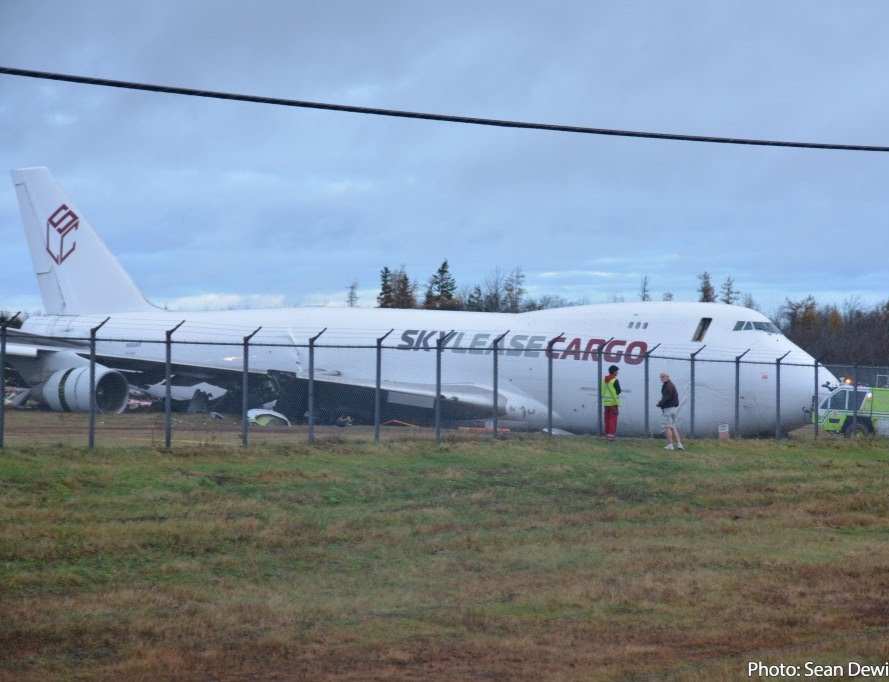
The Sky Lease Cargo Boeing 747-412F aircraft (U.S. registration N908AR, serial number 28026) was conducting flight 4854 (KYE4854) from Chicago/O’Hare International Airport, Illinois, U.S., to Halifax/Stanfield International Airport, Nova Scotia, with 3 crew members, 1 passenger, and no cargo on board. The crew conducted the Runway 14 instrument landing system approach. When the aircraft was 1 minute and 21 seconds from the threshold, the crew realized that there was a tailwind; however, they did not recalculate the performance data to confirm that the landing distance available was still acceptable, likely because of the limited amount of time available before landing. The unexpected tailwind resulted in a greater landing distance required , but this distance did not exceed the length of the runway.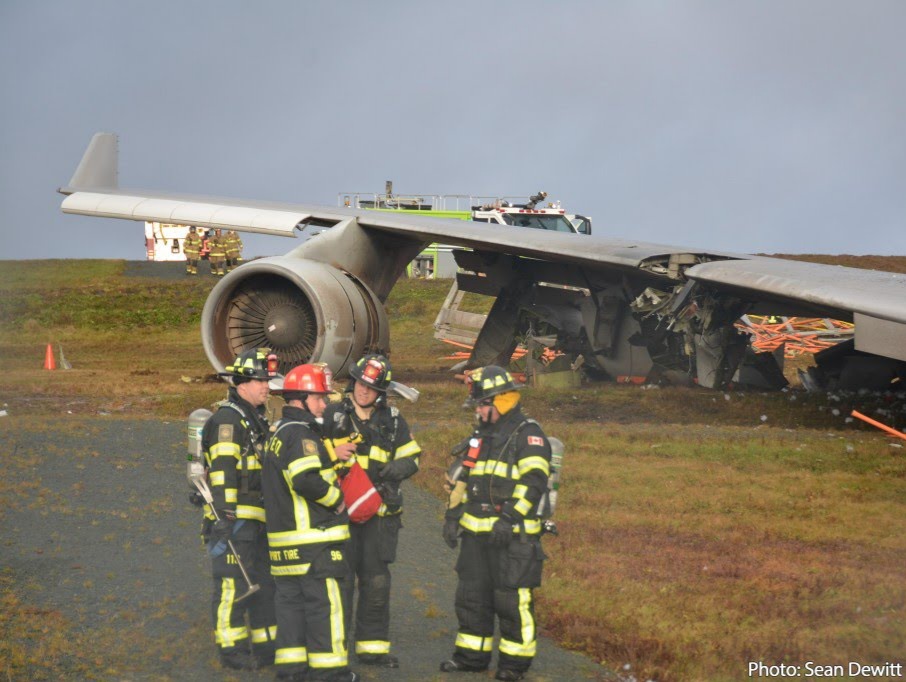 The aircraft touched down firmly at approximately 0506 Atlantic Standard Time, during the hours of darkness. After the firm touchdown, for undetermined reasons, the engine No. 1 thrust lever was moved forward of the idle position, causing the speed brakes to retract and the autobrake system to disengage, increasing the distance required to bring the aircraft to a stop. In addition, the right crab angle (4.5°) on initial touchdown, combined with the crosswind component and asymmetric reverser selection, caused the aircraft to deviate to the right of the runway centreline.
During the landing roll, the pilot monitoring’s attention was focused on the lateral drift and, as a result, the required callouts regarding the position of the deceleration devices were not made.
The aircraft touched down firmly at approximately 0506 Atlantic Standard Time, during the hours of darkness. After the firm touchdown, for undetermined reasons, the engine No. 1 thrust lever was moved forward of the idle position, causing the speed brakes to retract and the autobrake system to disengage, increasing the distance required to bring the aircraft to a stop. In addition, the right crab angle (4.5°) on initial touchdown, combined with the crosswind component and asymmetric reverser selection, caused the aircraft to deviate to the right of the runway centreline.
During the landing roll, the pilot monitoring’s attention was focused on the lateral drift and, as a result, the required callouts regarding the position of the deceleration devices were not made.
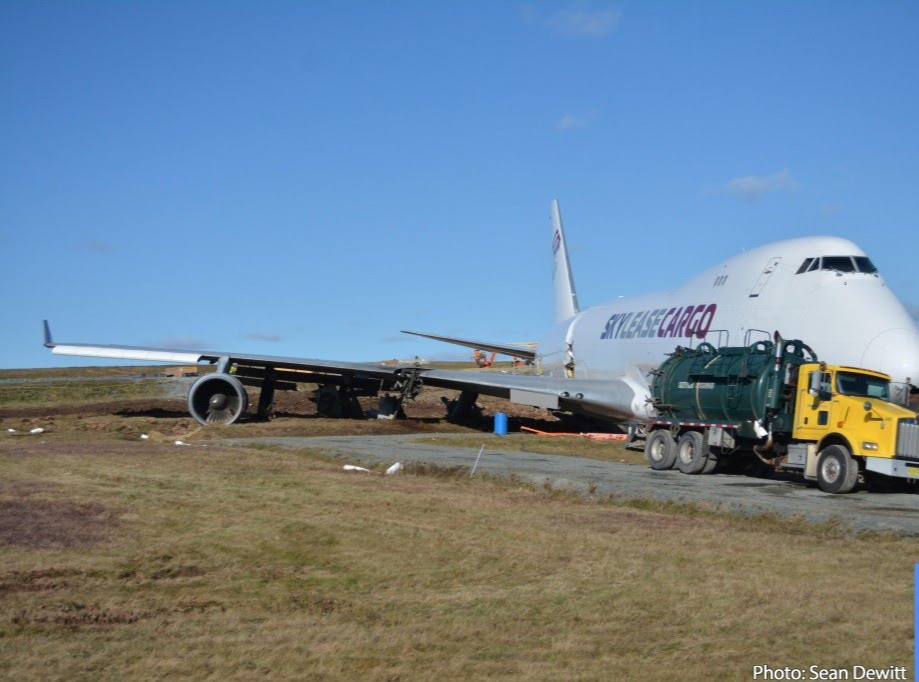
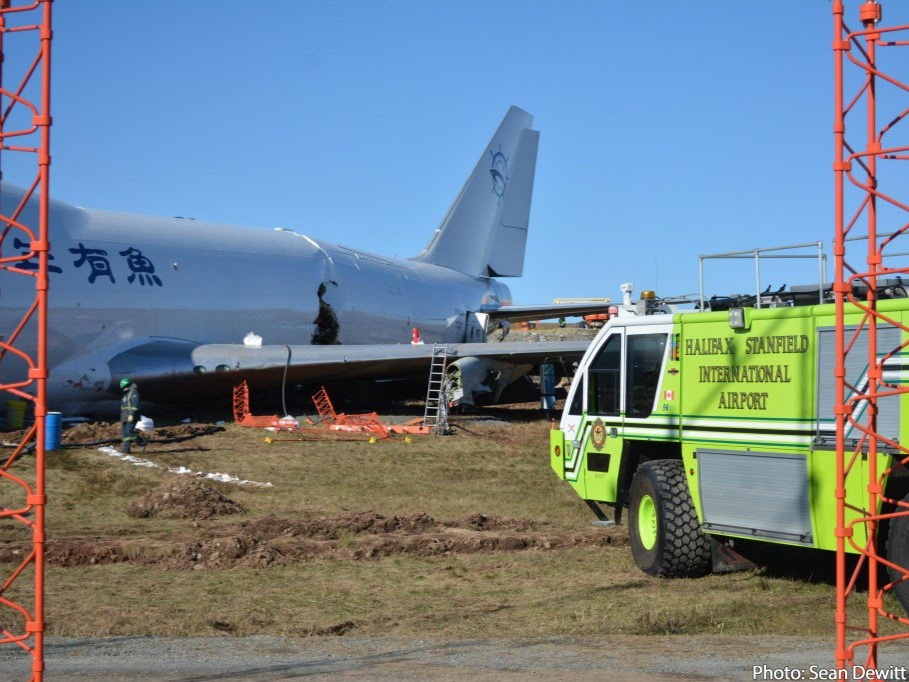 Although manual brake application began 8 seconds after touchdown, maximum braking effort did not occur until 15 seconds later, when the aircraft was 800 feet from the end of the runway. At this position, it was not possible for the aircraft to stop on the runway and, 5 seconds later, the aircraft departed the end of the runway at a speed of 77 knots and came to a stop 270 m (885 feet) past the end.
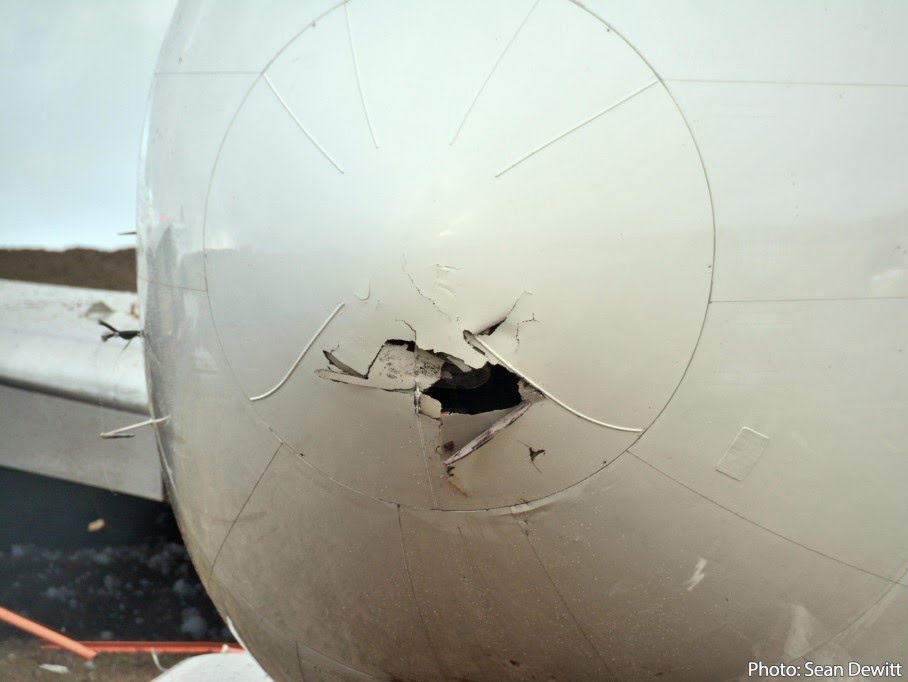
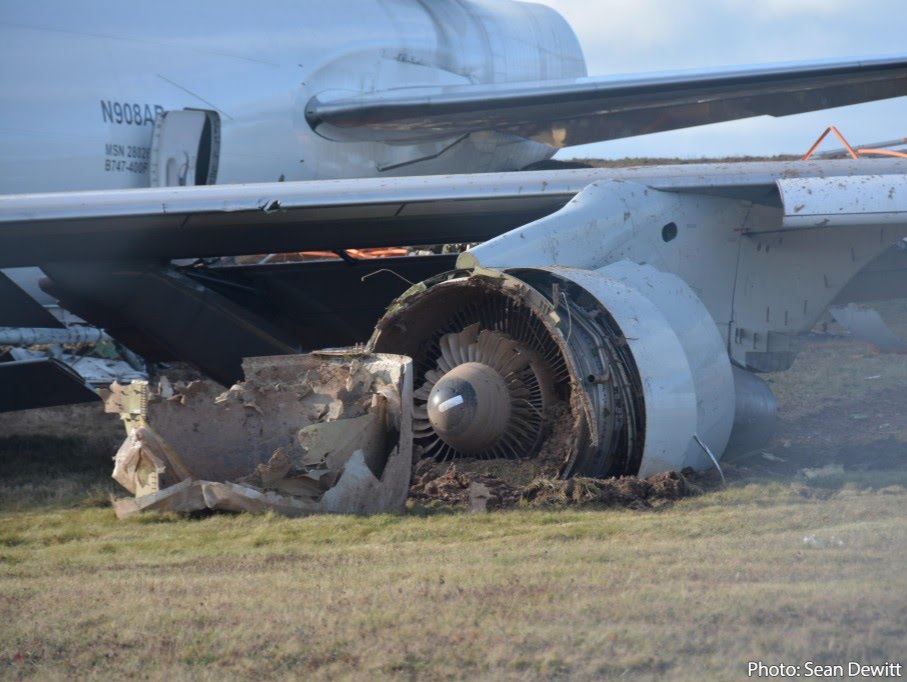
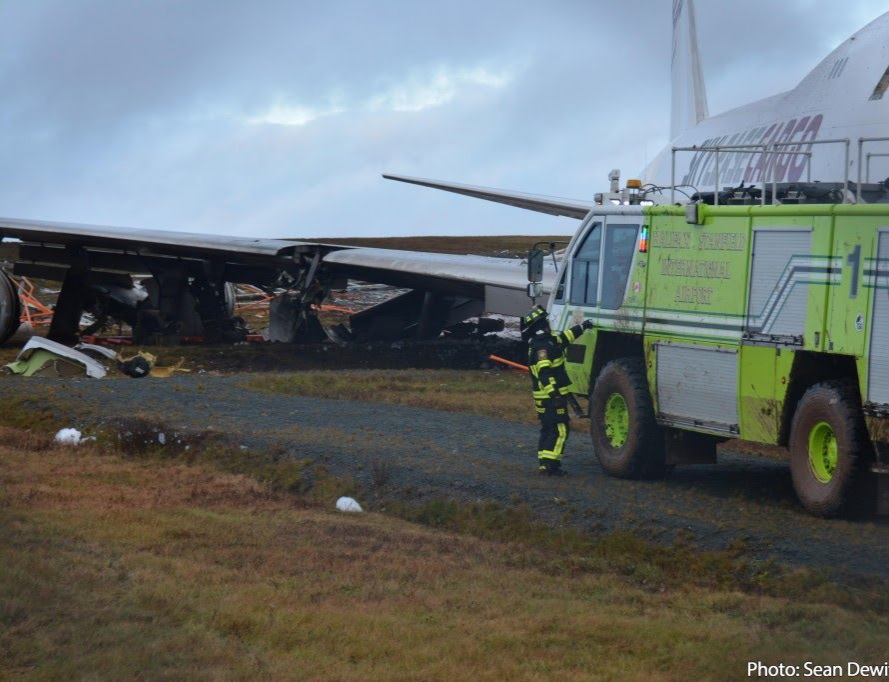
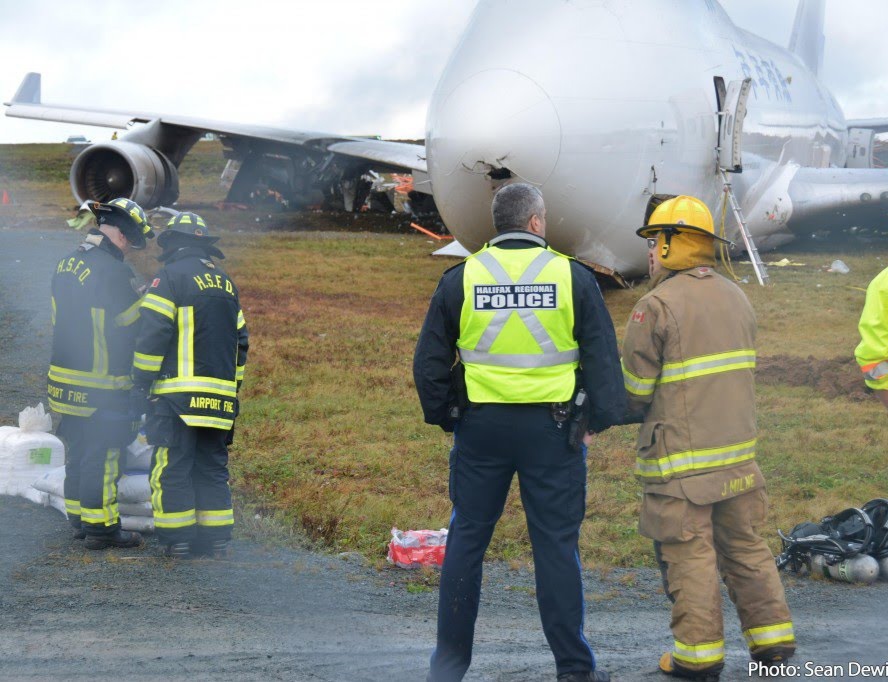
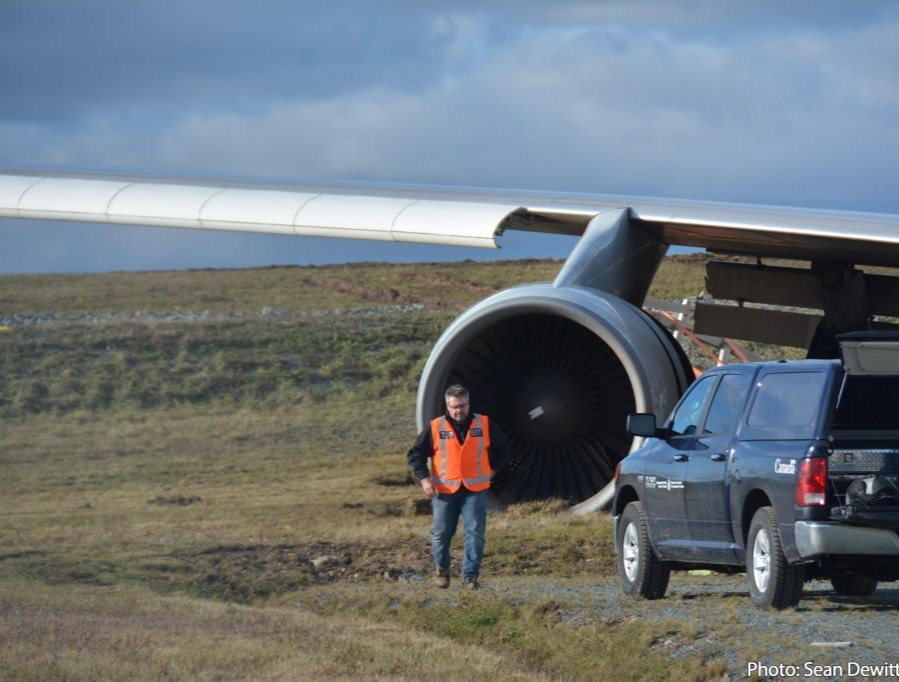
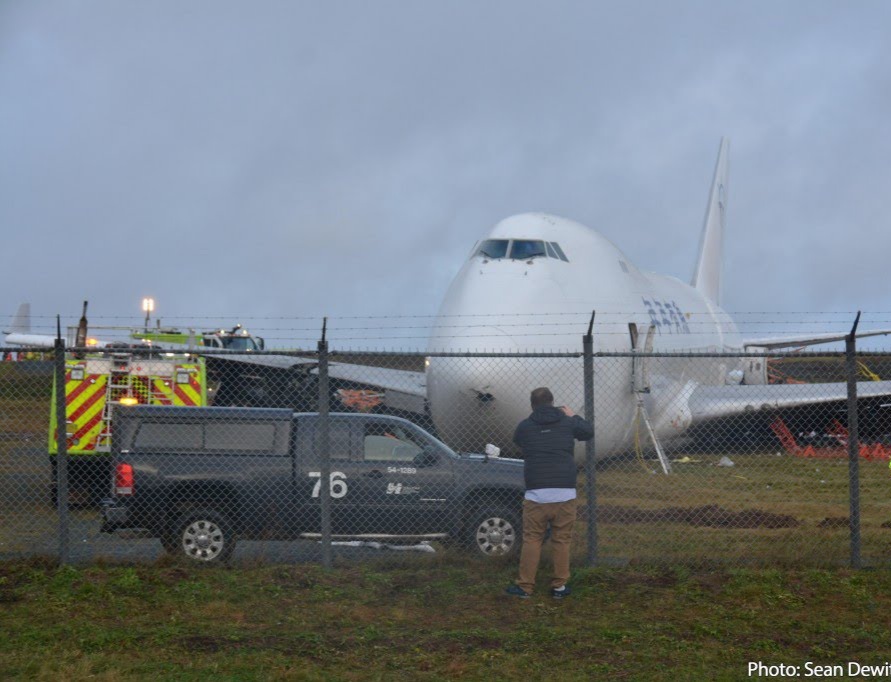
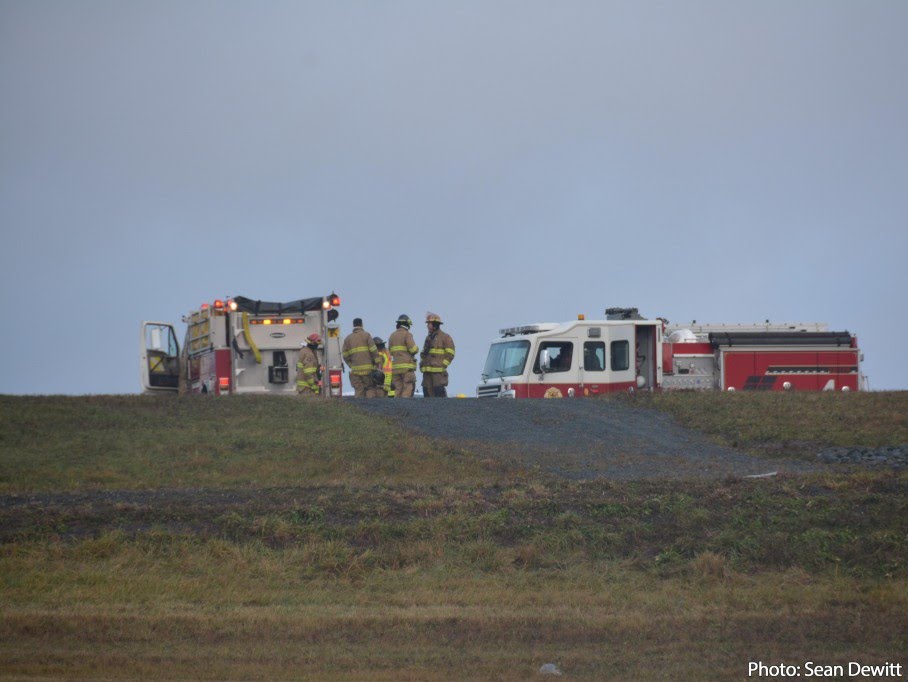
The aircraft struck the approach light stanchions and the localizer antenna array. The No. 2 engine detached from its pylon during the impact sequence and came to rest under the left horizontal stabilizer, causing a fire in the tail section following the impact. The emergency locator transmitter activated. Aircraft rescue and firefighting personnel responded. All 3 crew members received minor injuries and were taken to the hospital. The passenger was not injured.
Although manual brake application began 8 seconds after touchdown, maximum braking effort did not occur until 15 seconds later, when the aircraft was 800 feet from the end of the runway. At this position, it was not possible for the aircraft to stop on the runway and, 5 seconds later, the aircraft departed the end of the runway at a speed of 77 knots and came to a stop 270 m (885 feet) past the end.
The aircraft struck the approach light stanchions and the localizer antenna array. The No. 2 engine detached from its pylon during the impact sequence and came to rest under the left horizontal stabilizer, causing a fire in the tail section following the impact. The emergency locator transmitter activated. Aircraft rescue and firefighting personnel responded. All 3 crew members received minor injuries and were taken to the hospital. The passenger was not injured.
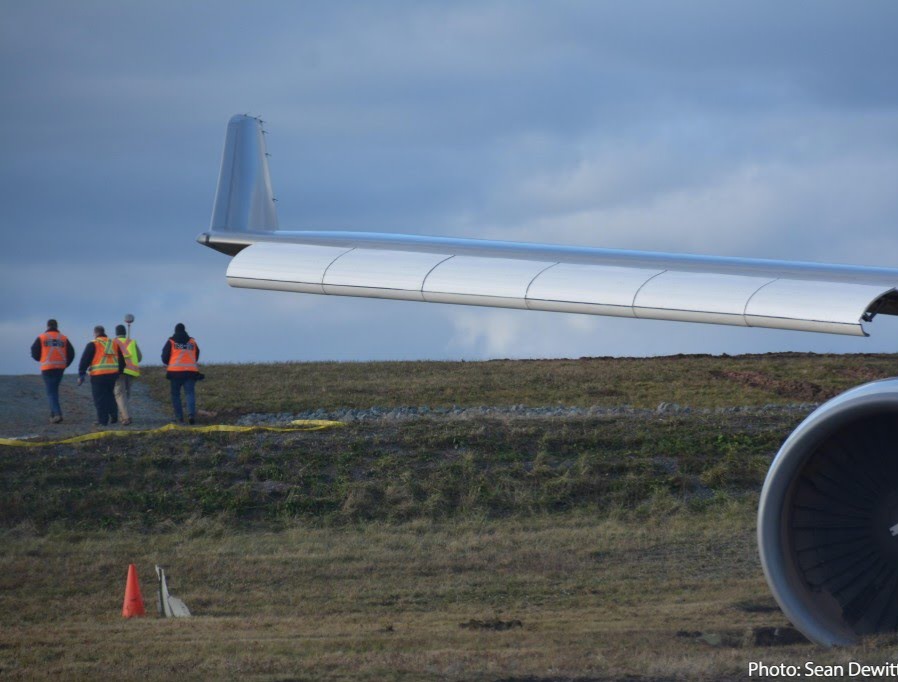
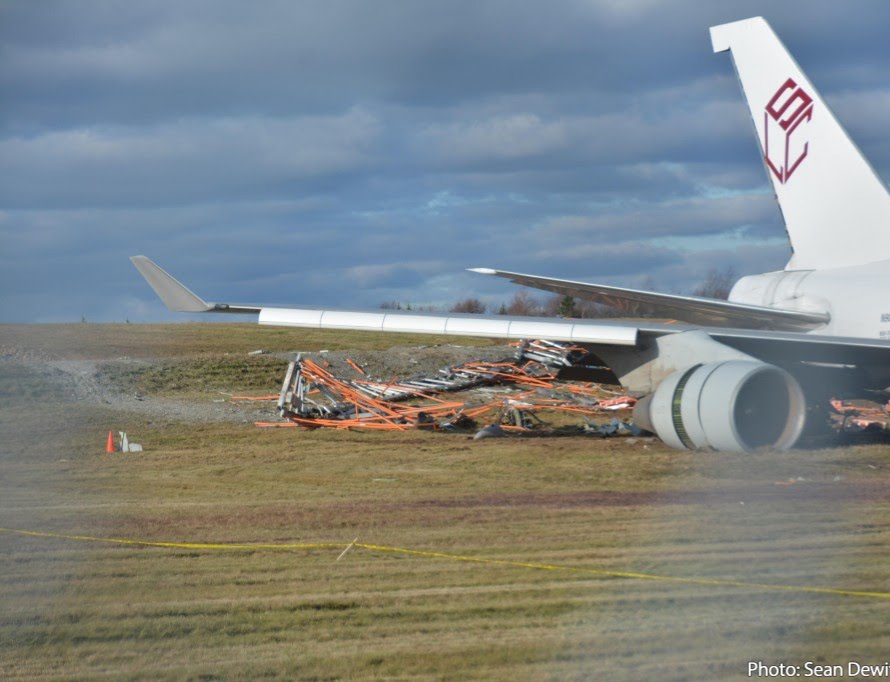 During the overrun, the aircraft crossed a significant drop of 2.8 m (9 feet) approximately 166 m (544 feet) past the end of the runway and was damaged beyond repair. While this uneven terrain was beyond the 150 m (492 feet) runway end safety area proposed by Transport Canada, it was within the recommended International Civil Aviation Organization runway end safety area of 300 m (984 feet). In 2007, the Board recommended that
the Department of Transport require all Code 4 runways to have a 300 m runway end safety area (RESA) or a means of stopping aircraft that provides an equivalent area of safety.
TSB Recommendation A07-06
1.0 Factual information
Information about the use of on-board recordings
 The International Civil Aviation Organization’s (ICAO’s) Annex 13* requires states conducting accident investigations to protect cockpit voice recordings. Canada complies with this requirement by making all on-board recordings privileged in the Canadian Transportation Accident Investigation and Safety Board Act. While the TSB may make use of any on-board recording in the interests of transportation safety it is not permitted to knowingly communicate any portion of an on-board recording that is unrelated to the causes or contributing factors of an accident or to the identification of safety deficiencies.
The reason for protecting on-board recordings lies in the premise that these protections help ensure that pilots will continue to express themselves freely and that this essential material is available for the benefit of safety investigations. The TSB has always taken its obligations in this area very seriously and has vigorously restricted the use of on-board recording data in its reports. Unless the on-board recording is required to both support a finding and identify a substantive safety deficiency, it will not be included in the TSB’s report.
The International Civil Aviation Organization’s (ICAO’s) Annex 13* requires states conducting accident investigations to protect cockpit voice recordings. Canada complies with this requirement by making all on-board recordings privileged in the Canadian Transportation Accident Investigation and Safety Board Act. While the TSB may make use of any on-board recording in the interests of transportation safety it is not permitted to knowingly communicate any portion of an on-board recording that is unrelated to the causes or contributing factors of an accident or to the identification of safety deficiencies.
The reason for protecting on-board recordings lies in the premise that these protections help ensure that pilots will continue to express themselves freely and that this essential material is available for the benefit of safety investigations. The TSB has always taken its obligations in this area very seriously and has vigorously restricted the use of on-board recording data in its reports. Unless the on-board recording is required to both support a finding and identify a substantive safety deficiency, it will not be included in the TSB’s report.
 To validate the safety issues raised in this investigation, the TSB has made use of the available on-board recording in its report. In each instance, the material has been carefully examined in order to ensure that it is required to advance transportation safety.
The International Civil Aviation Organization’s (ICAO’s) Annex 13* requires states conducting accident investigations to protect cockpit voice recordings. Canada complies with this requirement by making all on-board recordings privileged in the Canadian Transportation Accident Investigation and Safety Board Act. While the TSB may make use of any on-board recording in the interests of transportation safety it is not permitted to knowingly communicate any portion of an on-board recording that is unrelated to the causes or contributing factors of an accident or to the identification of safety deficiencies.
The reason for protecting on-board recordings lies in the premise that these protections help ensure that pilots will continue to express themselves freely and that this essential material is available for the benefit of safety investigations. The TSB has always taken its obligations in this area very seriously and has vigorously restricted the use of on-board recording data in its reports. Unless the on-board recording is required to both support a finding and identify a substantive safety deficiency, it will not be included in the TSB’s report.
To validate the safety issues raised in this investigation, the TSB has made use of the available on-board recording in its report. In each instance, the material has been carefully examined in order to ensure that it is required to advance transportation safety.
1.1 History of the flight
The Sky Lease Cargo Boeing 747-412F aircraft (U.S. registration N908AR, serial number 28026) was conducting flight 4854 (KYE4854), a multi-leg flight that originated at Chicago/O’Hare International Airport (KORD), Illinois, U.S., with a final destination of Changsha/Huanghua Airport (ZGHA), Hunan, China. The first leg of the flight was a positioning flight to Halifax/Stanfield International Airport (CYHZ), Nova Scotia, where cargo would be loaded onto the aircraft. The second leg of the flight was to Ted Stevens Anchorage International Airport (PANC), Alaska, U.S., for a technical stop to refuel and change crews before the aircraft would depart on its final leg to ZGHA.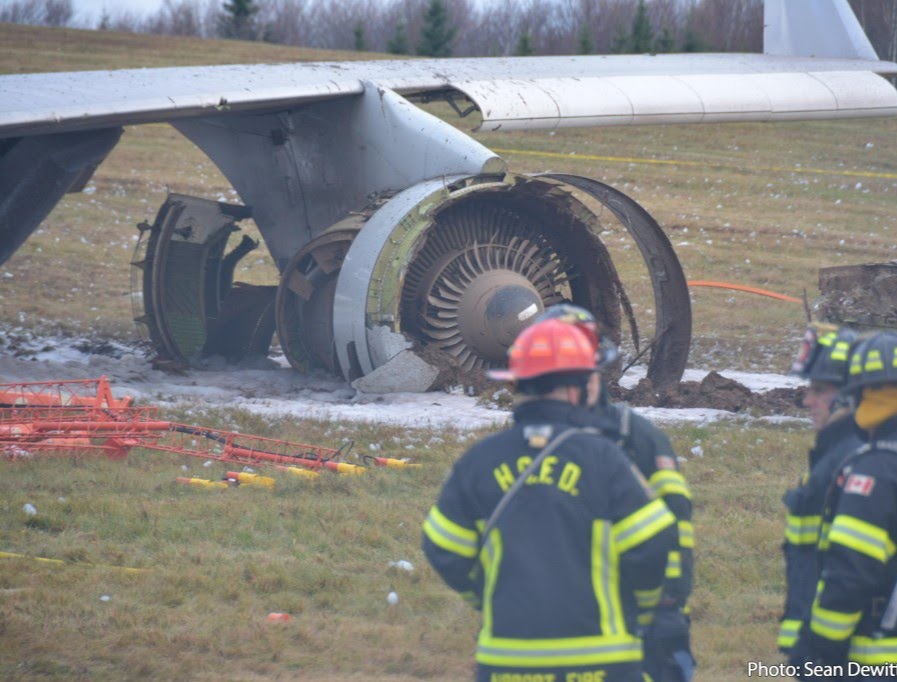 The occurrence flight was scheduled to depart KORD at 1230Footnote1 on 06 November 2018, with an augmented crewFootnote2 made up of a captain, first officer (FO), and international relief officer (IRO).Footnote3 This augmented crew would operate the first 2 legs of the flight, from KORD to CYHZ and then to PANC. Also on board the occurrence flight was a deadheading senior captain, who was in the passenger area on the upper flight deck during the flight.
The captain and FO arrived in Chicago on the evening of 05 November, and the IRO arrived in Chicago on the morning of 06 November.
On the morning of 06 November, the captain consulted with the company’s flight operations, and they decided jointly to delay the departure by 13.5 hours, until 0200 on 07 November. The decision was based on forecast low ceilings and visibility that were below the company’s approach minima for the active runway at CYHZ. The rest of the crew and the deadheading captain were informed of the delay by telephone and email.
The occurrence flight was scheduled to depart KORD at 1230Footnote1 on 06 November 2018, with an augmented crewFootnote2 made up of a captain, first officer (FO), and international relief officer (IRO).Footnote3 This augmented crew would operate the first 2 legs of the flight, from KORD to CYHZ and then to PANC. Also on board the occurrence flight was a deadheading senior captain, who was in the passenger area on the upper flight deck during the flight.
The captain and FO arrived in Chicago on the evening of 05 November, and the IRO arrived in Chicago on the morning of 06 November.
On the morning of 06 November, the captain consulted with the company’s flight operations, and they decided jointly to delay the departure by 13.5 hours, until 0200 on 07 November. The decision was based on forecast low ceilings and visibility that were below the company’s approach minima for the active runway at CYHZ. The rest of the crew and the deadheading captain were informed of the delay by telephone and email.
 In accordance with company policy, flight dispatch called the crew at 2300, 3 hours before the new departure time. The crew arranged to be picked up from the hotel at 0000. Operational paperwork—such as flight planning, weather, and NOTAMs—was emailed to the crew, who printed these documents at the hotel.
The crew received a briefing by telephone from flight dispatch about the route, the weather, and applicable NOTAMs. The deadheading pilot was included in the pre-departure planning discussion because he had several years of experience operating these flights with the company and he had flown into CYHZ the preceding week.
In accordance with company policy, flight dispatch called the crew at 2300, 3 hours before the new departure time. The crew arranged to be picked up from the hotel at 0000. Operational paperwork—such as flight planning, weather, and NOTAMs—was emailed to the crew, who printed these documents at the hotel.
The crew received a briefing by telephone from flight dispatch about the route, the weather, and applicable NOTAMs. The deadheading pilot was included in the pre-departure planning discussion because he had several years of experience operating these flights with the company and he had flown into CYHZ the preceding week.
 The pre-departure planning included preparing the weight and balance form which provided the departure and arrival runways. The Max Allowed Gross Weight Landing section of this form indicated 302 092 kg and flaps 25 for a landing on Runway 23, which was 10 500 feet (3200 m) long. However, after reviewing the weather and NOTAMs, the crew planned to land on Runway 14, which was 7700 feet (2347 m) long. After arriving at KORD, the crew met with maintenance staff, who provided a briefing of work completed on the aircraft while it was at KORD.
 Following a 1-hour delay due to a paperwork issue, the flight departed KORD at 0302 (14.5 hours after the original planned departure time) for the 2-hour flight to CYHZ. The captain was the pilot flying (PF) and occupied the left seat, while the FO was the pilot monitoring (PM) and occupied the right seat. The IRO was seated in the behind the PM.
During the cruise portion of the flight, the crew reviewed the weather at CYHZ based on automatic terminal information service (ATIS)Footnote4 information Sierra,Footnote5 which was issued at 0403 via the aircraft communication addressing and reporting system (ACARS). ATIS information Sierra indicated the following weather at 0400:
Following a 1-hour delay due to a paperwork issue, the flight departed KORD at 0302 (14.5 hours after the original planned departure time) for the 2-hour flight to CYHZ. The captain was the pilot flying (PF) and occupied the left seat, while the FO was the pilot monitoring (PM) and occupied the right seat. The IRO was seated in the behind the PM.
During the cruise portion of the flight, the crew reviewed the weather at CYHZ based on automatic terminal information service (ATIS)Footnote4 information Sierra,Footnote5 which was issued at 0403 via the aircraft communication addressing and reporting system (ACARS). ATIS information Sierra indicated the following weather at 0400:
- Winds from 230° magnetic (M) at 10 knots
- Visibility 7 statute miles (SM) in light rain and mist
- Broken ceiling at 500 feet above ground level (AGL)
- Overcast layer of cloud at 3600 feet AGL
- Temperature and dew point 15 °C
- Altimeter setting 29.68 inches of mercury (inHg)
- the landing runway was Runway 14 and the departing runway was Runway 23;
- the runway surfaces were bare and wet;
- the Runway 23 threshold was displaced;
- the instrument landing system (ILS) for Runway 23 and the Runway 05 localizer were unserviceable;
- Taxiway B was closed; and
- pilots should advise air traffic control (ATC) of the requested approach on initial contact.
 After reviewing ATIS information Sierra, at 0433, the PF conducted an approach briefing for Runway 14. The briefing included the landing distance required and approach speed based on the landing weight in the flight management system. The briefing also included the planned flap configuration of flaps 25 and the autobrake setting 4. According to data from the CYHZ tower, from 0413 until 0430, the winds were from 220°M to 230°M at 15 knots, gusting to 21 knots. At 0435, the winds were from 240°M at 15 knots, gusting to 22 knots.
At 0443, when the occurrence aircraft was 153 nautical miles (NM) from CYHZ, the crew began a descent from the cruising altitude of flight level (FL) 370.Footnote6
At 0446, the Moncton Area Control Centre (ACC) controller asked the crew which approach they were requesting for CYHZ. The crew requested the Runway 14 ILS approach, and the controller cleared the flight directly to the intermediate fix TETAR (Appendix A).
After reviewing ATIS information Sierra, at 0433, the PF conducted an approach briefing for Runway 14. The briefing included the landing distance required and approach speed based on the landing weight in the flight management system. The briefing also included the planned flap configuration of flaps 25 and the autobrake setting 4. According to data from the CYHZ tower, from 0413 until 0430, the winds were from 220°M to 230°M at 15 knots, gusting to 21 knots. At 0435, the winds were from 240°M at 15 knots, gusting to 22 knots.
At 0443, when the occurrence aircraft was 153 nautical miles (NM) from CYHZ, the crew began a descent from the cruising altitude of flight level (FL) 370.Footnote6
At 0446, the Moncton Area Control Centre (ACC) controller asked the crew which approach they were requesting for CYHZ. The crew requested the Runway 14 ILS approach, and the controller cleared the flight directly to the intermediate fix TETAR (Appendix A).
 Shortly before the occurrence flight landed, 3 other aircraft landed at CYHZ:
- a Boeing 757 aircraft landed on Runway 14 at 0444;
- a Boeing 757 aircraft landed on Runway 23 at 0452; and
- a Learjet 35 aircraft landed on Runway 14 at 0454.Footnote7

 At 0501, the Moncton ACC controller instructed the occurrence crew to transfer to the CYHZ tower frequency. On initial contact, the CYHZ tower controller informed the crew that the winds were from 260°M at 15 knots and asked if the crew had ATIS information Tango. The crew replied that they had Tango; however, they remained unaware that Runway 23 was available.
At 0502:46, when the aircraft was 8.6 NM from Runway 14, the CYHZ tower controller informed the crew that the winds were from 260°M at 16 knots, gusting to 21 knots. These winds would result in a steady 7-knot tailwind component. The controller asked the crew to confirm whether Runway 14 was still acceptable. The PM confirmed that Runway 14 was acceptable, and the tower controller repeated that the winds were from 260°M at 16 knots, gusting to 21 knots, and cleared the aircraft to land on Runway 14. The tower controller’s question as to the acceptability of Runway 14 prompted a brief conversation among the crew members about the perceived lack of runway options. However, the crew’s understanding was that only Runway 14 was available to them, and so continued the approach to Runway 14.
At 0504:10, the aircraft passed the final approach fix IMANO on the localizer and glideslope, and stabilized at the planned approach indicated airspeed (IAS) of 164 knots, with a ground speed of 185 knots. Just after passing the final approach fix, when the aircraft was 4.0 NM, or 1 minute and 21 seconds, from the threshold of Runway 14, the crew confirmed the presence of a tailwind and the PF confirmed with the PM the direction and speed of the wind. However, they did not change their approach speed. When the aircraft was passing through 800 feet AGL, the PF reviewed the go-around procedure with the crew.
At 0504:58, when the aircraft was 1.7 NM from the threshold, its IAS was 164 knots, and its ground speed was 174 knots. The tower controller reported that the winds were from 250°M at 15 knots, gusting to 21 knots.
At 0505:10, when the aircraft was at 400 feet AGL, the PF disengaged the autothrottle and autopilot. The IAS was 167 knots, and the ground speed was 174 knots.
At 0505:34, the aircraft crossed the threshold of Runway 14 at a height of 62 feet AGL, 12 feet above the threshold-crossing altitude of 50 feet, 27 feet left of centreline, with an IAS of 173 knots and ground speed of 179 knots.
At 0505:36, the thrust levers were brought to idle, the pitch attitude increased from 0.9° to 2.6° nose-up, and the aircraft touched down firmly 1350 feet past the threshold of Runway 14. At that point, it had an IAS of 168 knots and ground speed of 179 knots.
Over the following 40 seconds, a number of events happened in rapid successi
At 0501, the Moncton ACC controller instructed the occurrence crew to transfer to the CYHZ tower frequency. On initial contact, the CYHZ tower controller informed the crew that the winds were from 260°M at 15 knots and asked if the crew had ATIS information Tango. The crew replied that they had Tango; however, they remained unaware that Runway 23 was available.
At 0502:46, when the aircraft was 8.6 NM from Runway 14, the CYHZ tower controller informed the crew that the winds were from 260°M at 16 knots, gusting to 21 knots. These winds would result in a steady 7-knot tailwind component. The controller asked the crew to confirm whether Runway 14 was still acceptable. The PM confirmed that Runway 14 was acceptable, and the tower controller repeated that the winds were from 260°M at 16 knots, gusting to 21 knots, and cleared the aircraft to land on Runway 14. The tower controller’s question as to the acceptability of Runway 14 prompted a brief conversation among the crew members about the perceived lack of runway options. However, the crew’s understanding was that only Runway 14 was available to them, and so continued the approach to Runway 14.
At 0504:10, the aircraft passed the final approach fix IMANO on the localizer and glideslope, and stabilized at the planned approach indicated airspeed (IAS) of 164 knots, with a ground speed of 185 knots. Just after passing the final approach fix, when the aircraft was 4.0 NM, or 1 minute and 21 seconds, from the threshold of Runway 14, the crew confirmed the presence of a tailwind and the PF confirmed with the PM the direction and speed of the wind. However, they did not change their approach speed. When the aircraft was passing through 800 feet AGL, the PF reviewed the go-around procedure with the crew.
At 0504:58, when the aircraft was 1.7 NM from the threshold, its IAS was 164 knots, and its ground speed was 174 knots. The tower controller reported that the winds were from 250°M at 15 knots, gusting to 21 knots.
At 0505:10, when the aircraft was at 400 feet AGL, the PF disengaged the autothrottle and autopilot. The IAS was 167 knots, and the ground speed was 174 knots.
At 0505:34, the aircraft crossed the threshold of Runway 14 at a height of 62 feet AGL, 12 feet above the threshold-crossing altitude of 50 feet, 27 feet left of centreline, with an IAS of 173 knots and ground speed of 179 knots.
At 0505:36, the thrust levers were brought to idle, the pitch attitude increased from 0.9° to 2.6° nose-up, and the aircraft touched down firmly 1350 feet past the threshold of Runway 14. At that point, it had an IAS of 168 knots and ground speed of 179 knots.
Over the following 40 seconds, a number of events happened in rapid successi