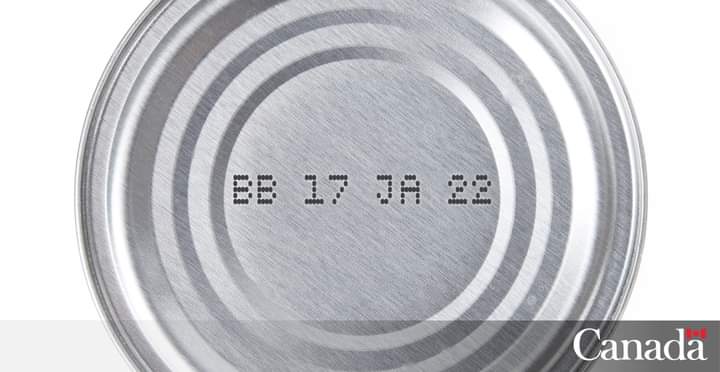
Date labelling on pre-packaged foods
Information about dates on pre-packaged food is a valuable source of information for consumers.
A basic understanding of what terms are used can help you to better understand these labels. There are different kinds of date markings, depending on the product. The most common terms are "best-before" dates, "packaged on" dates, and expiration dates. Knowing what these terms mean will help you understand the labels, which in turn will help you make informed choices about the food you buy."Best-before" date
A "best-before" date, also known as a durable life date, tells you when the durable life period of a prepackaged food ends. Durable life means the anticipated amount of time that an unopened food product, when stored under appropriate conditions, will retain its:- freshness,
- taste,
- nutritional value, or
- any other qualities claimed by the manufacturer.
Packaging dates
"Packaged on" dates are similar to "best-before" date but are used on retail-packed foods with a durable life date of 90 days or less, and must be accompanied by durable life information either on the label or on a poster next to the food. The durable life information can be expressed several ways, for example, the number of days a product will retain its freshness, or a best-before date. Together, the "packaged on" date and durable life information tell consumers about the anticipated amount of time that an unopened food product will retain its quality and freshness.Expiration date
An expiration date is not the same as a best-before date. Expiration dates are required only on certain foods that have strict compositional and nutritional specifications which might not be met after the expiration date. Expiration dates must be used on the following products:- formulated liquid diets (nutritionally complete diets for people using oral or tube feeding methods)
- foods represented for use in a very low-energy diet (foods sold only by a pharmacist and only with a written order from a physician)
- meal replacements (formulated food that, by itself, can replace one or more daily meals)
- nutritional supplements (food sold or represented as a supplement to a diet that may be inadequate in energy and essential nutrients)
- human milk substitutes (infant formula)
Other date markings
The Food and Drug Regulations state the terms "use by" and "employez avant" may replace "best before" for prepackaged fresh yeast only. It must be presented in the same form and manner as the best-before date. Other voluntary date marking systems may be useful to consumers. These may appear on food products as long as they are not misleading and the label meets appropriate requirements. These include:- "sell by" dates
- "prepared on" dates
- "freeze by" dates
- "manufactured on" dates
Foods on which best before dates should appear
Foods that will keep fresh for 90 days or less, and are packaged at a place other than the retail store, from which they are sold, must have the following on the label:- a best-before date, and
- proper storage instructions (if different from normal room temperature).
- a best-before date and storage instructions, or
- a "packaged on" date with accompanying information about the durable life of the food (such as the number of days a product will retain its freshness) on the label or on a poster next to the food.
Determining the durable life
It is the responsibility of the manufacturer or retailer to determine:- if the product has a durable life of 90 days or less, and
- the specific durable life information for the products they sell.
Best-before dates on products with a shelf life greater than 90 days
Foods with an anticipated shelf life greater than 90 days are not required to be labelled with a best-before date or storage information. This is because these foods are generally considered to be shelf stable. Examples include most canned foods, many dry foods such as pasta and foods that are sold in a frozen state. If manufacturers and retailers choose to provide customers with this information, they must follow the required manner of declaration (see the next section).How a best-before is shown on a label
The best-before date must be identified using the words "best before" and "meilleur avant" grouped together with the date, unless a clear explanation of the significance of the best-before date appears elsewhere on the label. Similarly, packaged-on dates must also be grouped together with the date, using the words "packaged on" and "empaqueté le". The best-before date may appear anywhere on the package. If it is placed on the bottom, this has to be indicated elsewhere on the label. The month must be in both official languages or indicated by using specified bilingual symbols. The year is optional, unless it is needed for the sake of clarity (for example, if the shelf life extends into a new calendar year). If included, the year must appear first, followed by the month, then the day. Example:Best before 17 JA 30 Meilleur avant
- JA: January
- FE: February
- MR: March
- AL: April
- MA: May
- JN: June
- JL: July
- AU: August
- SE: September
- OC: October
- NO: November
- DE: December