Cold weather experiments at home
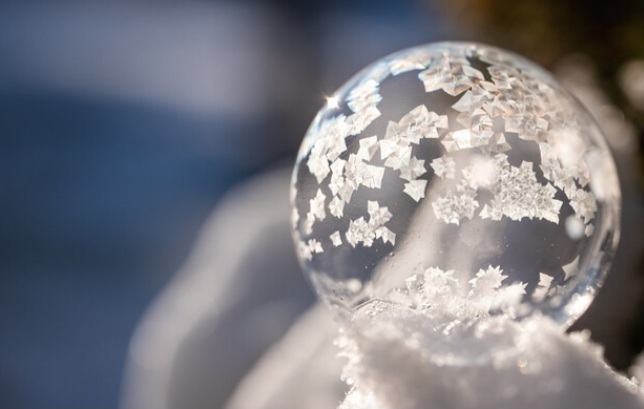
Bored at home this winter? Who said cold weather can’t be fun? Here are a few “at home” science experiments that will help you appreciate our Canadian cold temperatures! Creating snow bubbles Essentially created with common household ingredients, cold weather and slow, steady breathing, snow bubbles have become a ocial media phenomena! To create “snow bubbles” you need air temperatures of -20°C or colder, and absolutely no wind – the slightest breeze will make your bubble pop.
 Check our WeatherCAN app to confirm that these weather conditions are occurring, and then mix:
- 200 ml of warm water;
- 35 ml of corn syrup;
- 35 ml of liquid dish soap; and
- 2 tbsp. of sugar.
 Shrink a balloon!
When the weather is super chilly, trapped pockets of air contract. It’s possible to visualize this with a balloon!
Blow a balloon up indoors, making careful note of its dimensions using string and a ruler. Now take the balloon outside for a few moments, and see how much less string is required to measure the dimensions. If you do the opposite and start the experiment outdoors, the balloon may expand enough upon walking inside that it pops! That contraction of gas is also why we have to fill our tires with more air in the wintertime.
Before heading out to play in the cold, make sure to dress warmly! Here are some cold weather safety tips.
Shrink a balloon!
When the weather is super chilly, trapped pockets of air contract. It’s possible to visualize this with a balloon!
Blow a balloon up indoors, making careful note of its dimensions using string and a ruler. Now take the balloon outside for a few moments, and see how much less string is required to measure the dimensions. If you do the opposite and start the experiment outdoors, the balloon may expand enough upon walking inside that it pops! That contraction of gas is also why we have to fill our tires with more air in the wintertime.
Before heading out to play in the cold, make sure to dress warmly! Here are some cold weather safety tips.