**** NSHA Media Release
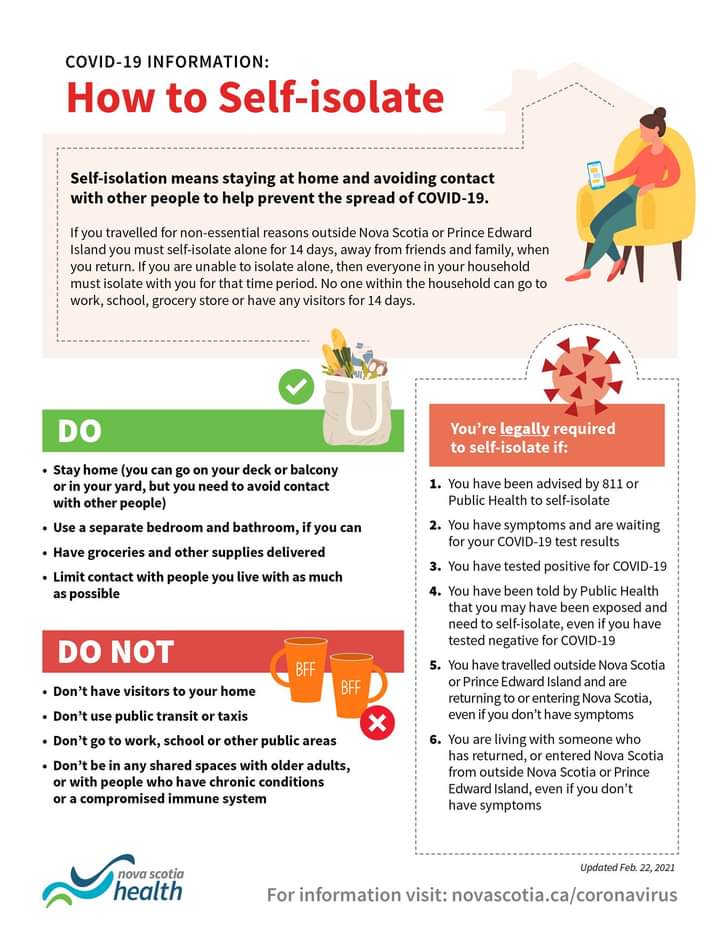
Self-isolation is required if you travelled for non-essential reasons outside Nova Scotia or Prince Edward Island, in certain cases while you wait for COVID-19 test results and more.
Learn when and how you should self-isolate.
Self-isolation requirements
You’re legally required to
self-isolate for 14 days or as directed by Public Health if you:
If you’re legally required to self-isolate, you need to
self-isolate for the full 14 days or as directed by Public Health, even if you’ve tested negative for COVID-19 or get the vaccine.
Legal proceedings
Individuals engaged in a legal proceeding (including the accused, victim, witness or party in the proceeding) can enter the province to participate in the legal proceeding, but they must
self-isolate for the period of time they’re in the province other than when they’re in court and follow
social distancing guidelines.
Military, defence and police
Canadian Military and Defence Team, Coast Guard, RCMP, Canadian Border Services Agency and Canadian Security Intelligence Service personnel and their families can enter the province to house hunt, but they must
self-isolate for the period of time they’re in the province other than when they’re looking at properties and follow
social distancing guidelines. They also need to self-isolate once they move to Nova Scotia or for any other visit to the province.
Rotational workers (working outside the province)
Rotational workers (like Alberta oil workers) are individuals who live in Nova Scotia and travel to work in another province, territory or country on a regular schedule (up to 4 weeks home at a time). Rotational workers who work in a province or territory outside Nova Scotia and Prince Edward Island or outside Canada need to self-isolate for the period of time they’re in the province (up to 14 days) and follow the Health Protection Act Order and the
Directive Under the Authority of the Chief Medical Officer of Health – COVID-19 Exceptions for Rotational Workers (PDF 483 kB).
Rotational workers can:
- interact with people who live in their household, including children under a joint custody order or agreement who visit or live part-time in the household, without physical distancing, unless rotational workers become unwell (household members don’t need to self-isolate unless they become unwell)
- spend time outside on their own property
- go for a drive
- go for a walk, run, hike, bike or ATV ride off their property (if they encounter people from outside their household they must wear a mask and maintain a distance of 2 metres)
- visit a park, beach, or other outdoor public space (if they encounter people from outside their household they must wear a mask and maintain a distance of 2 metres)
- spend time at their cabin or vacation home (or a rental location) in Nova Scotia, following the same rules they would at home
- drop off and pick up household members at school, work or recreational activities without getting out of their vehicle
- use no-contact pickup options for groceries or other items purchased online without getting out of their vehicle
- visit a drive-in theatre without getting out of their vehicle
- go through a drive-through, like at a restaurant or bank
- attend necessary (urgent and routine) medical appointments – this includes appointments with physicians and nurse practitioners, dentists, optometrists and other regulated health professionals where in-person treatment is required
In the 14 days after they arrive in Nova Scotia, rotational workers can't:
- enter public places (like schools, grocery stores, shopping malls, banks, religious institutions, restaurants and bars)
- attend indoor or outdoor gatherings
- visit people from outside their household
- let people from outside their household visit them on their property or in their home
- volunteer or work in any way that puts them in contact with people outside their household
If a rotational worker or someone living in the household travels outside Nova Scotia or Prince Edward Island for non-essential travel,
everyone in the household needs to self-isolate for 14 days, unless there is a separate space where the traveler can self-isolate alone.
Rotational workers who work in a province or territory outside Nova Scotia and Prince Edward Island or outside Canada must be tested for COVID-19 during their modified self-isolation. They need to get tested 2 times (once on day 1 or 2 and again on day 6, 7 or 8 of their modified self-isolation). Rotational workers also need to
self-isolate for the full 14 days, even with negative test results. Learn more:
Rotational Workers Self-Isolation and Testing Factsheet (PDF 471 kB)
Temporary foreign workers, fishers and offshore workers
Temporary foreign workers can enter the province, but they must
self-isolate upon arrival for 14 days. If they can, they should self-isolate onsite where they are planning to work.
Fishers entering the province to board a fishing vessel or get supplies must
self-isolate for 14 days when they arrive, unless they can self-isolate on the fishing vessel for 14 consecutive days before leaving the vessel. They can’t leave the boat for any reason, including to get supplies. They can dock and have supplies delivered.
Offshore workers can enter the province for work, but they must
self-isolate upon arrival for 14 days.
Exemptions from self-isolation
Some people are exempt from the self-isolation requirement. Even if you’re exempt, you still need to follow
social distancing guidelines. You need to watch for
symptoms and self-isolate if you start to feel sick.
People who are exempt from the self-isolation requirement include:
- residents of Nova Scotia and Prince Edward Island when they travel within Nova Scotia and Prince Edward Island (Atlantic travel bubble)
- people from outside Nova Scotia or Prince Edward Island who have already self-isolated for 14 days in Prince Edward Island before they enter Nova Scotia
- visiting or leaving Nova Scotia to drop off or pick-up children under a joint custody order or agreement if both the children and the person bringing them don’t have symptoms of COVID-19
- people who need to routinely travel between Nova Scotia or New Brunswick to work or attend a school or post-secondary institution located in Nova Scotia or New Brunswick if they follow the Health Protection Act Order and the Protocol Under the Authority of the Chief Medical Officer of Health – COVID-19 Protocol for Nova Scotia-New Brunswick Travel (PDF 638 kB)
- people who need to travel between Nova Scotia and New Brunswick to drop off or pick up people or things, or accomplish other tasks that are necessary and can’t be done virtually if they follow the Health Protection Act Order and the Protocol Under the Authority of the Chief Medical Officer of Health – COVID-19 Protocol for Nova Scotia-New Brunswick Travel (PDF 638 kB)
- people visiting or leaving Nova Scotia for essential health services, plus support people travelling with them
- workers who are essential to the movement of people and goods, and who must enter Nova Scotia as part of their work requirements (not for personal reasons or other types of work)
- healthy trade and transportation workers who are employed in the movement of goods or people across the Nova Scotia border, including truck drivers, crew, maintenance and operational workers on any plane, train or ship
- Canadian Armed Forces and Canadian Defence Team personnel, Coast Guard, Royal Canadian Mounted Police (RCMP), Canadian Border Services Agency and Canadian Security Intelligence Service
- first responders, including police, fire and Emergency Health Services (EHS) paramedic workers
Workers exempt from self-isolation
Workers exempt from the self-isolation requirement should follow
social distancing guidelines as much as they can and also follow public health directives. They need to watch for
symptoms and self-isolate if they start to feel sick.
If an exempt worker or someone living in the household travels outside Nova Scotia or Prince Edward Island for non-essential travel,
everyone in the household needs to self-isolate for 14 days, unless there’s a completely separate space where the traveller can self-isolate alone.
Compassionate exceptions from self-isolation
People from outside Nova Scotia or Prince Edward Island can request an exception to the self-isolation requirement for compassionate purposes. Exceptions will be considered for:
- visiting an immediate family member who is nearing end of life
- attending a funeral or service (like a burial or celebration of life) for an immediate family member; exceptions are not granted to attend public visitations
If you’re granted an exception, you’ll be allowed to do that specific activity, but you must
self-isolate for the period of time you’re in the province (up to 14 days) other than when you’re visiting the immediate family member or attending the service. Even if you have an exception, you still need to follow
social distancing guidelines. You need to monitor your symptoms closely, and self-isolate if you start to feel sick.
If you don't need a compassionate exception and are travelling to Nova Scotia or Prince Edward Island, you need to complete a
Nova Scotia Safe Check-in Form (self-declaration) to enter Nova Scotia.
Send your compassionate exception request to
c19compassionate@novascotia.ca and include the following travel details:
- name of travellers
- purpose of travel
- confirmation that the need to travel is urgent
- where you’re travelling from and how you’ll get to Nova Scotia
- where you plan to stay in Nova Scotia
- any travel within the 2-week period before you visit Nova Scotia
- any known exposure to COVID-19 for all travellers
- your plan for self-isolation during your stay, including details about how food and supplies will be delivered, how you’ll maintain a physical distance of 2 metres (6 feet) from others where you’re staying (if applicable) and how you’ll follow Public Health directives and guidelines
If your exception request is for visiting an immediate family member who is nearing end of life, your request also needs to include:
- written confirmation (or email) from your immediate family member’s care team that your family member is near end-of-life and that you have been given permission to visit, if applicable
- name of the facility where you’ll be visiting your immediate family member, if applicable
- confirmation that your relative’s home care provider is aware that you’ll be visiting your family member from outside of Nova Scotia or Prince Edward Island, if applicable
If your exception request is for attending a funeral or service for an immediate family member, your request also needs to include:
- written confirmation that the funeral is for an immediate family member (you need an obituary or funeral announcement or a letter from the funeral home confirming date of service and your relationship to deceased)
- details about the service (for example, how many people are expected to attend, if the service is open to the public or invitation only)
If permission is granted, you will receive a confirmation email indicating approval and the conditions. When you arrive in Nova Scotia you need to show this document to border officials.
Specialized worker exceptions from self-isolation
Workers from outside Nova Scotia and Prince Edward Island can receive an exception to the self-isolation requirement for urgent and critical on-site work that requires specialized skills unavailable in Nova Scotia or Prince Edward Island. This includes, for example:
- people who are essential to the inspection, installation or repair of specialized equipment
- people who are essential to the maintenance and repair of critical infrastructure
- people who are essential to the completion of large construction projects
Specialized workers are allowed to work and travel to and from the workplace, but must self-isolate for the period of time they’re in the province (up to 14 days) other than when they’re working. Specialized workers need to follow the Health Protection Act Order and the
Directive Under the Authority of the Chief Medical Officer of Health – COVID-19 Exceptions for Specialized Workers (PDF 475 kB).
Before each trip to Nova Scotia, specialized workers from outside Nova Scotia or Prince Edward Island need to complete a
Nova Scotia Safe Check-in Form (self-declaration).
When you arrive in Nova Scotia you need show that you submitted the form by providing the confirmation email you receive after submitting the form to border officials.
Businesses
Businesses located in Nova Scotia that have more than 10 specialized workers entering Nova Scotia from outside Nova Scotia or Prince Edward Island within a 1-month period, need to provide details about their Workplace COVID-19 Prevention plan to
c19businessexceptions@novascotia.ca before specialized workers travel to the province.
Gathering limits
You need to follow gathering limits, unless your group has an exemption identified in the
Health Protection Act Order (PDF).
The following gathering restrictions are in place:
- Households can have gatherings up to 10 people in their home including people who live there without social distancing (if your household is more than 10 people you can’t have any visitors); when you go into the community, your household can stay together without social distancing no matter how many people are in the household – when shopping, try to have 1 person from your household go into a store to help keep customers and staff safe.
- Gathering limit for close social groups - you can form a close social group of up to 10 people without social distancing; you should try to keep this group consistent.
- Indoor gathering limit with social distancing for events and activities hosted by a recognized business or organization - 50% of the venue’s capacity up to 100 people maximum indoors (including spectators of sports and performing arts). Events and activities include:
- arts and culture events
- sports (recreational, amateur and professional), recreational and physical activity events
- festivals
- special events
- social events
- faith gatherings, weddings and funerals (including receptions and visitation)
- bingo, darts and other activities hosted by licensed and unlicensed establishments following the Guidelines for Games and activities in licensed establishments (PDF)
- Outdoor gathering limit with social distancing for events and activities hosted by a recognized business or organization - 15